In the world of stage lighting, halogen lamps have long been the standard for front lighting. These lamps consume a lot of power and produce a significant amount of heat instead of using electricity more efficiently to generate light. Because of this, we want to give a brief insight into what can be saved by switching to modern LED fixtures.
Fresnel lamps are used as stage lights in everything from local clubs to the largest concert halls. The lamps come in various models, but some standard categories are 650W, 1000W, and 2000W halogen lamps. These categories indicate the maximum power consumption of the lamps and reflect the amount of light they produce. LED fixtures are often divided into corresponding categories, and we refer to Cameo’s F-series when discussing these categories.
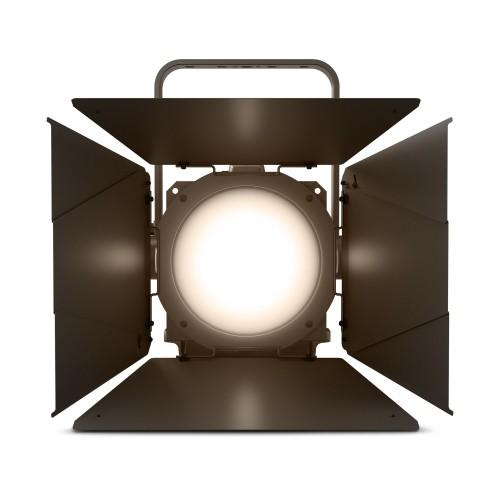
Cameo has designed fixtures to match the categories mentioned above, where the F1, F2, and F4 correspond to 650W, 1000W, and 2000W respectively. In this text, we assume that based on the amount of light output, the LED Tungsten (T) versions of the fixtures correspond to these categories, and we recalculate the Full Color (FC) versions of the fixtures based on this to determine their power consumption relative to the amount of light produced.
If we take the least efficient lamp in the F-series and compare it with its halogen equivalent, we end up with the F1 FC, which provides a 47% energy savings compared to a 650W halogen lamp. This is based on a lower lumen output and higher power consumption than the F1 T version, and is recalculated to match the lumen output of the F1 T version.
If instead we look at the more energy-efficient T versions of the entire series—which are also closer in functionality to conventional halogen lamps—we achieve a minimum power savings of 76%. In the chart, you can see how much of the halogen lamp’s power consumption each of the F-series fixtures uses.
To get an idea of what this will save in costs, we take as an example a medium-sized conference hall that uses six fixtures—either 1000W halogen lamps or F2 T LED lamps. Assuming an operating time of 8 hours per day, 3 days a week, 45 weeks a year, this comes to 144 hours per week and 6,480 hours per year. By using Norgespris (A spot price that keeps the price steady during the entire year), this lighting rig of six lamps will cost NOK 19,440 per year when using halogen lamps. If we replace these with LED fixtures, the annual cost drops to just NOK 4,082.40. This is a savings of NOK 15,357.60 per year in electricity costs alone.

Based on this, we strongly recommend switching to LED fixtures wherever conventional halogen lamps are in use. In venues where lighting is used extensively, the investment will pay for itself within a few years, even before considering the savings from not having to replace bulbs in conventional lamps.
The numbers used in this article are based on Cameo’s stated specifications and their description of products designed to match the indicated categories. We cannot guarantee 100% accuracy in these calculations, but they provide solid guidance and visualization of the potential savings when switching to LED fixtures. Additionally, LED technology has advanced significantly in just a few years, and where older fixtures delivered lower light quality, Cameo’s F-series now offers a CRI above 90%, ensuring excellent color rendering.
If you have questions about switching to LED or other energy-saving solutions in your technical setup, we look forward to hearing from you. Feel free to check out our other blog posts or browse our online shop.